-
 United Kingdom
United Kingdom





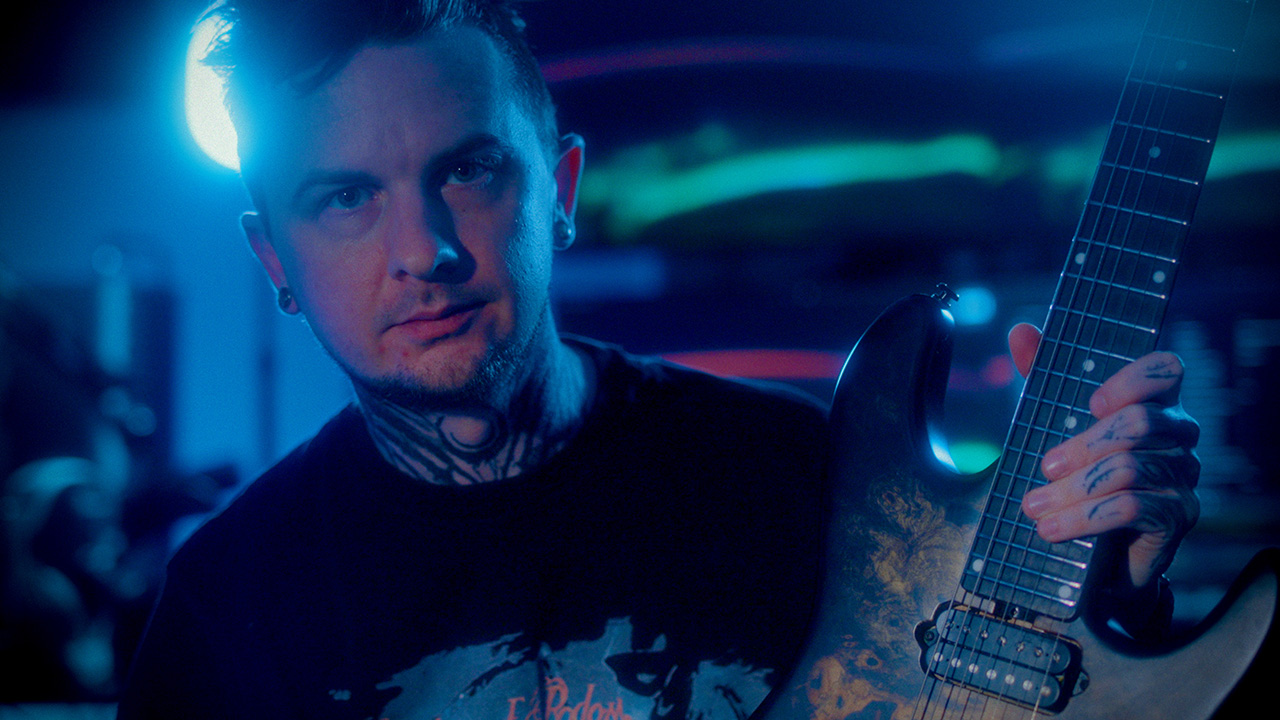
I guess guitar playing to me, it's life, because it's just what I do more than anything else. I play guitar more than I walk, or more than I talk. So it really is just my whole life, is playing guitar. It's just what I do, from the minute I wake up until the minute I go to sleep.
There was a moment, a vivid moment, I was six years old, and I remember it so clearly. So I was watching Hee Haw with my family and we all just sat around and watched Hee Haw at night. There was the banjo champion of 1976, and it was this kid, and he was playing with Roy Clark. He was playing this Orange Blossom special.
(music)
And he was playing it on a banjo. And Roy Clark, and I was like, "Oh my God, oh my God." And that was the exact moment where I was like, "I want to play guitar," but I don't know why it wasn't banjo. Good thing it wasn't. But that was the exact moment in 1976. I was six years old where I said, "I have to play guitar." And most people, it's Eddie Van Halen, or Ace, or Jimi Hendrix or anything, but yeah, it was Hee Haw for me, which is so odd.
(music)
I was so drawn to the guitar. I didn't know how to play, I didn't know anything, but I just knew when the guitar was around me, I didn't even know anything, it just made me feel better. It was kind of like food or water, or air or something. I just kind of felt comfortable and I didn't know anything about the guitar. I just would hold it all the time. I was just so drawn to the guitar. I don't know if the guitar chose me, or I chose it.
(music)
I was really obsessed with Kiss, and still am, and if anybody knows me. And I remember I heard that Gene Simmons was involved with the Van Halen album, because I read every interview of Kiss, and I went to the record store and Van Halen one was out, and this was 1978. And I remember seeing Gene Simmons' name on the back of the record and I was like, "Oh, I got to buy this." Then I was just like, "Oh, my God, I was obsessed with it."
(music)
I was so obsessed with it, and I just learned every rip and every...
(music)
All that stuff. And then Van Halen two came out.
(music)
And so that was such an epiphany for me, was Van Halen. And then throughout my life, just I had all these influences and epiphanies. And thank God for it. I think that's one of the most important things, is being influenced by something, because it will change your life forever. Someone could see a movie, or see a basketball player, or a baseball player, and it will change their life until the day they die. And it's just incredible.
(music)
When I was a little kid, before I started playing guitar, I was really into Frankenstein, the Wolf Man, the Mummy, Creature from the Black Lagoon, Dracula, all the classic Universal monsters. And then I remember it was June, I remember I could remember these dates, it was June of 1977. I was walking through Sears with my mom and I saw Kiss, Love Gun. And I was like, "Oh, my God," because it was like monsters with guitars. I was like, "This is the greatest thing that's ever happened to me," because I loved music and I loved monsters. I think when you're young, you're like a sponge, and you're crabbing onto all this stuff, because you've never seen it before. And all those things that influenced me, and I saw it still, are with me today, nothing's really changed. Rock music and monsters, they just go hand in hand.
(music)
Where I grew up, it's called Grosse Pointe, Michigan. It's a beautiful place. Everything is perfect, and all the houses are beautiful, but I would play these nightclubs, these dirty nightclubs in Detroit, and I was so young and I would just play them forever. But my mom said, "As long as you get up for school," because I never smoked, I never drank, I never did any of that stuff. So my parents didn't worry about that, but they were like, "As long as you get up for school." And after playing these clubs, you would get home at like a thousand o'clock. And so I had to get up and I was like, "Ugh," but I knew I had to go to school or my mom wouldn't let me play these clubs.
So these two guys, this is such a weird story, I don't really talk about this either, these two guys from Warner Brothers Records saw me and took me out to California, and introduced me to people and all that stuff. And it was so weird. You think about it today, just bringing this kid out to California, young kid underage, but it was the greatest thing, thank God for it too. I just came out here and started working right away.
(music)
I was doing sessions. I met Bob Marlette, who's an incredible producer. He introduced me to a lot of people. And what I did is I studied every kind of music when I was growing up. Everything, rock and country, and jazz, and swing, all this stuff. They were like, "Do you want to do a session for John Wetton?" I was like, "Of course." "Or Robin Zander," I was like, "Yeah." "Or Baywatch, or Hard Copy." I just took anything, and I did it half the price of everyone else. So everyone wanted to use me. They were like, "There is this dumb kid that'll do it for half the price." I understood the session world. They wanted to get my take and get it over with so they could get to the vocal or whatever like that. So I just would go and play and I would do the Jay Leno Show, or anything they had for me. I would do everything, and I loved it. My phone was ringing so much. I would do it for half of the price and half of the time. So they were like, "Call that guy."
(music)
I never wanted to depend on any certain kind of gear. I always wanted to know that I could go to Guitar Center, buy whatever I needed off the wall and do a show.
I mean, I got to have my telly, I use a Fender heavy pick. I'll use any amp. But the Ernie Ball strings, and I've said this in other interviews, these strings, because I'm so freaked out about breaking a string or things like that because I'm such a perfectionist, I want the shows to go perfect. I mean, perfect, perfect. I don't want to play out of tune, or out of time. So I'm so paranoid of just breaking a string or something going down. But the strings I use, these Ernie Ball strings, they don't break.
I did a whole European tour on one pack of strings, and I played, I think it was like 22 shows or something like that. Kept the same strings on. I'm doing this interview, and I have the same strings on. They have not changed. They're the same strings. That is very comforting to know. It's kind of like a safety net. You know these strings are not going to break or go out of tune or something like that. So I'm not a real gear person, but I just love stuff that is built well and built to last.
(music)
I've known Nikki for most of my life, I've known Tommy for most of my life. I didn't know Vince, but I would say I was closer to Mick than Nikki and Tommy. I was really close with Mick. When I would go see Mötley Crüe, I'd be in Mick's dressing room. But of course, I love Nikki and Tommy, and I've known them forever too. So I would write with Nikki. We wrote, for Meatloaf we did Bad Out of Hell III, The Monsters Loose. I wrote some Sixx:A.M songs with him. And everything me and Nikki wrote was very successful. We just wrote really well together. I mean, Nikki is one of the great lyricists and great songwriters, and we worked on The Dirt song for the movie.
So I knew the guys. I was like Oliver from the Brady Bunch. I was like the cousin Oliver. I was always around the guys, and I love them, and they love me. And that's when said, "Oh, I want to retire." And Nikki asked me if I'd be interested, and of course, I would love to. And they know I've been playing those songs probably as long as they've been playing them. And I think Mick was really, because I have such respect for Mick, and he knows that, and I love him, and it was a really good transition, and it's just worked out perfectly. It's just wonderful. Mick gave us the greatest riffs and the greatest songs in the world in 40 years. 40 years. I mean, applaud, Mick. It's incredible. So I just love being there, and I just couldn't be happier.
(music)
You look at musicians back in the '30s and the '40s, you listen to those songs. It was all live. And if somebody messed up in that orchestra, stop. Everybody, "Oh, God." You couldn't mess up. I love that. I love that. There were pros before there were pro tools.
When I go in the studio now, and I do these instrumental songs, I kind of imagine myself in the '30s or '40s. It's kind of a game for me. When I play live, I want to see how perfect I can get it, how perfect. And anybody watching thi, or you guys right here, you see how perfect you can get a song that you've played a million times. You'll be surprised how your time wavers; or if you hit that string too hard, or if you're a little behind or a little ahead. You'll be surprised. And that's what I do live.
And when I joined Mötley Crüe, people were like, "Oh, it sounds too perfect." It was maybe the greatest compliment I've ever gotten. I just love those compliments. "It sounds too perfect. It's too clean." I love those. It's such a great compliment.
(music)
Because I've come from being a session player. I come from that world. So when you're making a record, I don't care who you are, you have to be on time, and you have to be in tune. You can't make a mistake, because if you do, they'll say, "Let's try that again. Let's try that again." So I just brought that school of thought into playing live. You are there to make that artist sound great. And you don't want to mess up, or you don't want to play out of tune or sloppy, because that will distract who you're working for. So I always thought, "Do it like you're in the studio."
(music)
Nowadays, everybody has a phone. So you're being recorded. And I tell people at my shows, I'm like, "Hey, if you got a cell phone, record. You can record the whole show if you want. It's your phone, you could do whatever you want with it." So at all of my shows, people are right here, let's say like this, they'll be right here. And I'm totally fine with it, because I like that. It's a challenge.
(music)
When you're playing in certain venues, it's very echoey, right? It sounds like garbage, because you're in these cement places like indoor arenas or things like that. You have to play so clean to make it sound good. I remember seeing Rush on the Signals Tour, or AC/DC for Those About to Rock Tour. It was unbelievable. It sounded so good. And I would read interviews and see why, how did it sound so good? And their gain was so... They used not a lot of gain when they were playing live, and it just cut. I was like, "Wow."
Or when I saw The Police, I was like, "It sounds incredible." They didn't use a lot of gain, so I'll adjust my sound to the venue, and that's what I do a lot.
(music)
I think that's why I've been working as much as I have, because I will listen to what the artist is saying. I'll sometimes say, "I'm going to record this conversation so I can listen back to it." And they're like, "Okay, this is what I want, blah, blah, blah, blah, blah, blah, blah, and blah, blah, blah, blah, blah." And I'll listen and I'll make notes of that. I'll play it exactly how it was recorded, because who am I to go, "Eh, I think I can do a little bit better than this hit song that sold millions of records. I think I'm going to throw a couple arpeggios in there."
If that's what they wanted, they would've done that. So I play it exactly how it's written and recorded, and I use myself as an example, because when I would go see bands, that's how they would play it, how it was recorded.
(music)
And it sounds perfect. But you don't change those things, because ever since we were kids, those songs are burned in our head. And you're getting to that favorite part of the song, "Oh my God, here comes that part," and it's different. You're like, "Oh man, that's a drag." So that's why I always play it just like how it is on the record. And sometimes they'll say, "Oh no, change it up here or change it up there." That's when you change it up.
Maybe that's why I've stayed busy most of my life, because it's not my show. I remember Manson would say, "Oh, you could do that when you do a solo thing." And he was right. So I can do whatever I want when I go do a solo thing, but when I'm doing something like that, keep it like this. You're there for that artist; you are not there for yourself. It doesn't say the band, featuring this guy. It doesn't. It's you're there for that artist to make them sound as good as possible.
(music)
I never had a backup, but that's why I got all the tattoos, because I was like, "I don't have any plan B, this is just what I'm going to do." And so it's so strange because, when they say, "What if you don't make it?" And not make it as in being a famous guitar player, but just to be an accession musician. I never thought I wouldn't. I think that's very important for people to think. They just go, "Okay, this is what it's going to be." And if you think that way, and you work hard, that's what it's going to be. And I tell people that. They're like, "What do I do to get to..." I'm like, "Just obsess over it, and it's all you do. No girlfriends, no movies, no hanging out with the guys. You're at home, the master of your craft. And if you want it, you can do it. Why not? Of course, of course."
(music).
I never thought, "Oh, I want to be..." It's even hard to say, "I'm going to be a rockstar." That was like saying, "I'm going to be President of the United States." It just seemed so impossible, because when we all grew up, they were untouchable. They were untouchable. They were gods. There's no way that's going to happen. And so I didn't even dream about that. I didn't even think that I would be playing on a David Lee Roth record, or a Lynyrd Skynyrd record, or Mötley Crüe. Are you nuts? That's insane. It's insanity. So I was just like, "Oh, I just want to play sessions, or commercials, or TV shows," or whatever. I never thought that at all, but if you work hard enough, you can actually do anything you want.
(music)
Little jazz in there.
Yeah. Love that.
Jazzy John 5.
When people ask me how do I do this, or how do I do that, They're like, "How do I be a session guy," or, "I want to be a rockstar," or something like that. "I want to get into the business." I always give them the harsh answers and I say, "Where do you live?" And they're like, "I live in White Wall, Indiana." And I'll say, "Okay, well, here's what you do. You got to get out of Whitewall, Indiana, and you got to move to California. And then what you have to do is you got to put a band together and you start playing live. And nowadays you got to put YouTubes out, and you got to put Instagrams out of you playing, make yourself known. And you work every day, eight hours a day like it's a job. You network, you do this, you do that, and you don't give up for years, years and years and years." "But every day, not Saturday and Sunday off, every day you work eight hours a day on your craft. You make calls, you practice."
And it's hard for people to hear that. They're like," Huh?" So it is very difficult to leave the nest. People don't want to leave White Wall, Indiana and move into a dirty apartment in Hollywood. It's terrifying. "I don't know anybody there" I like my places the night. It's hard. But that's what I tell them.
One of the very first songs that I was taught, and a very cool riff, a great exercise, was this.
(music)
And that's exactly how I played it when I was seven years old. I don't know if it's right, but that's exactly how I was taught that riff. And I always played it like that.
So the love and hunger for it has never changed, which is so weird. We'll be playing some weird club, and I'll be so excited. That hunger and that excitement has never gone away. Even if it's the dead of winter and it's terrible, it's never gone away, that excitement. And I pray that it never does. All right.
We're rolling.
Okay. Sorry, guys.
(music)